

بسم الله الرحمن الرحيم
In the Name of Allah, the Most Gracious the Most Merciful
Abu Lahab was a staunch enemy of Prophet Muhammad ﷺ from the moment he called Quraysh to Islam. Abu Lahab was a wealthy businessman, whose materialistic worldview caused him to value money over religion. This mindset remains prevalent in contemporary capitalist society.
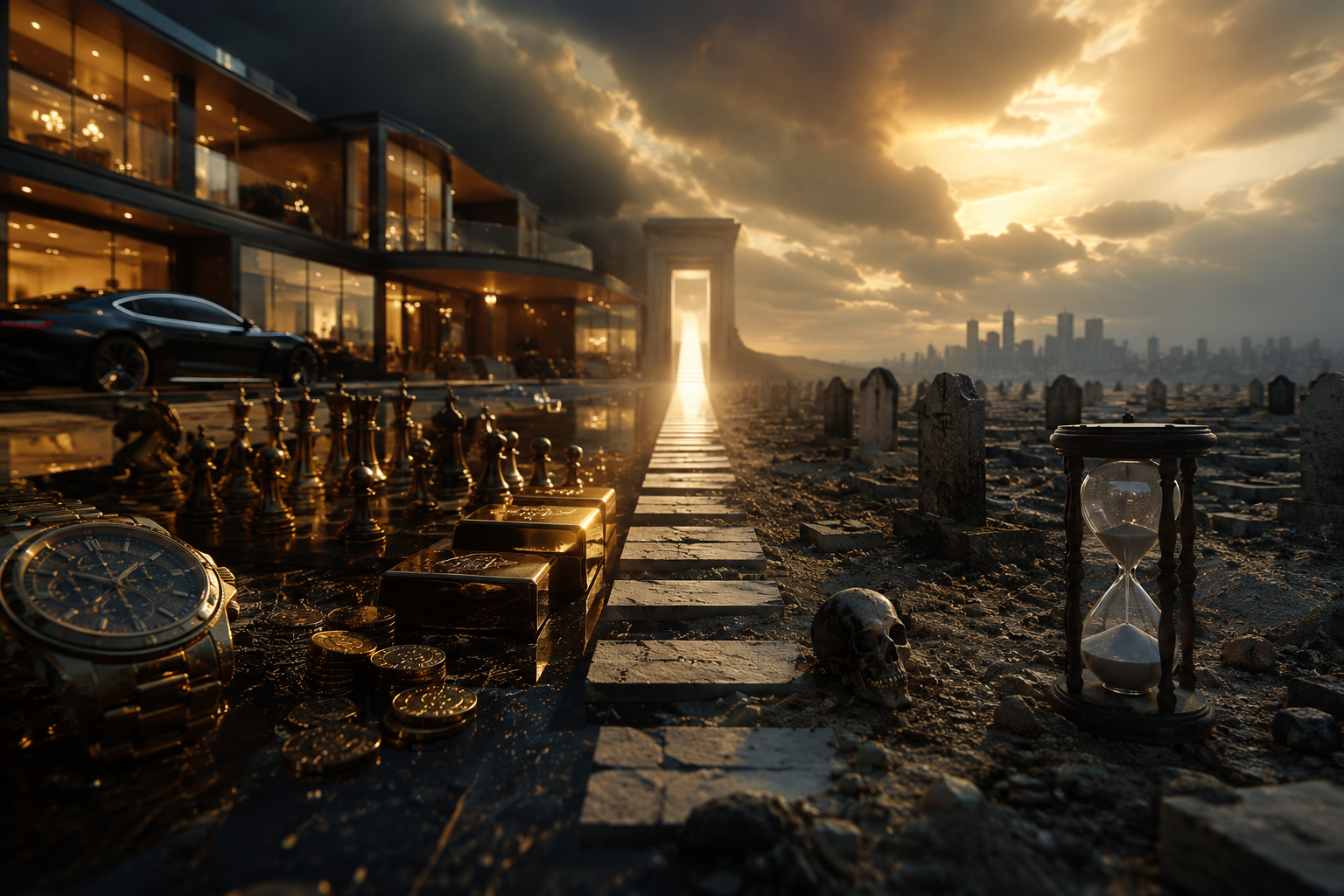
Billionaires devote their lives to accumulating wealth and status, believing that death can be delayed and money shields from divine accountability. This article argues that modern billionaires possess an Abu Lahab mindset, and how the ultra rich are often heedless of the afterlife.
On Mount Safa, the Prophet ﷺ made a historic call. He had been commanded by Allah to publicly deliver the Message of monotheism. To address the Quraysh tribes, the Prophet climbed the mountain and called:
"O Sabahah!” (Be on your Guard)
The people said, "Who is that?"
Then they gathered around him, whereupon he said, "Do you see? If I inform you that cavalrymen are proceeding up the side of this mountain, will you believe me?"
They said, "We have never heard you telling a lie."
Then he said, "I am a plain warner to you of a coming severe punishment."
He called them to the truth, warning them of the punishment on the Day of Judgement.
The people didn’t respond until Abu Lahab reacted badly and said:
"May you perish! You gathered us only for this reason? "
(Ṣaḥīḥ al-Bukhārī, no. 4971)
The Mindset of Abu Lahab
Abu Lahab’s response is notable as he was the Prophet’s uncle. He’d also been in the presence of Quraysh chiefs and felt comfortable speaking for the entire tribe, demonstrating a high status. Therefore, if he had publicly supported his nephew this may have influenced Quraysh’s reaction, possibly softening their stance.
This raises the question of why Abu Lahab had been quick to undermine the Prophet, and what prompted his angry response. The clue can be found in his occupation. He’d been a businessman, and the Prophet called the people to Mount Safa during business hours.
As Abu Lahab didn’t send a messenger on his behalf, he came in person - suggesting he must’ve closed his shop. Therefore he believed he’d made a financial loss by responding to the call.
Abu Lahab’s wealth was noted by Surah Al-Masad which was revealed after the incident at Mount Safa. Allah says:
Neither his wealth nor ˹worldly˺ gains will benefit him.
It should be noted that wealth itself is not evil. When used to support others it becomes a source of blessings and endless reward. There were wealthy Muslims in this time, including Abd al-Raḥmān ibn ʿAwf and ʿUthmān ibn ʿAffān. They were immensely wealthy, yet their wealth flowed outward through charity, public works, and support for the Muslim community.
Abu Lahab wasn’t condemned for being rich. It was because he believed his wealth made him self-sufficient and above religious accountability. This is evidenced by his later remarks:
"It has been mentioned from Ibn Masʿūd that when the Messenger of Allah ﷺ called his people to faith, Abu Lahab said: 'If what my nephew says is true, then I will ransom myself on the Day of Resurrection from the punishment with my wealth and my children.' So Allah revealed: 'His wealth and what he earned will not benefit him.'"
(Ibn Kathīr, 2003, commentary on Q. 111:2)
This toxic mindset is grounded in materialism – a word described by the Miriam Webster dictionary as the following:
Overly concerned or preoccupied with material possessions rather than with intellectual or spiritual things
This explains Abu Lahab’s dismissive response to the religious call. If the material world is more relevant than the spiritual, Abu Lahab would’ve considered the speech a waste of time. This is the ‘Abu Lahab mindset’ which diminishes religion in favour of wealth.
Money becomes an object of worship when one is overly attached to it. This can be shown in the lifestyle of modern billionaires. The below section argues they possess an Abu Lahab mindset and clarifies its main characteristics.
Wanting to Live forever
In 2023 Bryan Johnson, a billionaire tech entrepreneur spent $4 million in pursuit of a singular goal: do not die. Over three years, he developed Project Blueprint, a data driven regimen in which doctors worked to slow biological ageing. He took over 100 supplements a day, underwent laser treatments and monitored his exercise via algorithms. The 46 year old CEO claimed the diet plan has given him the ‘bones of a 30 year old’ and ‘heart of a 37-year-old.’
Other billionaires like Amazon CEO Jeff Bezos and Palantir boss Peter Thiel have invested in biotechnology to slow down aging in the body. The goal is to prolong youth and vitality.
For Bryan Johnson, his ambition was to change what it means to be human.
A TIME magazine described Johnson’s views on the afterlife:
He believes death is optional. He plans never to do it.
By undergoing ‘age related treatment’ Johnson wanted to slow down and delay aging. The idea was to optimise his lifespan as a means to extend it.
In July 2026, the billionaire’s goals were hampered after revealing that he’d been diagnosed with a chronic autoimmune condition. Johnson described that ‘his stomach is eating itself.’
Despite maintaining his health, Johnson’s external appearance could not prevent internal illness. For those who run from death it will meet them, and no treatment will block its arrival. This is illustrated in Surah Al-Qiyamah.
when the soul reaches the collar bone as it leaves.
and it will be said, “Is there any healer? Who can save this life?”
And the dying person realizes it is their time to depart
This reality was understood by Abbasid Caliph Harun al Rashid, who once owned a multicontinental caliphate. He once spoke with a man named Buhul, asking for a beneficial reminder. Buhul questioned the caliph about the fate of his forefathers and their palaces, to which al-Rashid answered they were dead and their dwellings left behind.
Buhul then delivered some lines of poetry.
“Consider the expanse of your palace in the world.
Would that your grave after death is more expansive.
Caliph Harun wept and said: ‘Give me more.”
Buhul continued:
If you set about to amass the treasures of Caesar
And you live for many years, then what?
Isn’t the grave the end of every living?
And won’t you be queried afterwards concerning all these?
When Caliph Harun returned home he fell ill a few days later. Weeping, he gathered his armies and said. “O One Whose kingdom does not terminate, have mercy on the one whose kingdom has come to an end.”
He died shortly after, leaving behind the wealth and palaces which do not benefit the dead.
(Al Areefi, 2016, 52-3)
Building Heaven on Earth
Billionaires are often characterised by their fear of death. Like Abu Lahab, they wish to ransom their wealth to protect themselves. On this earth, the megarich turn to their vast resources to distract from death - indulging in hedonistic enjoyment and lavish luxury.
Mark Zuckerberg famously built a Hawaiian bunker that was meant to survive an apocalypse. Its architecture was carefully crafted and tightly guarded, stocked with resources. It also contained an underground chamber, designed that when the world came to an end, the house would survive its collapse.
A Guardian article criticises the bunker as an ‘elitist fantasyland’ and reflects on why billionaires would conduct such projects:
The rich can’t buy their way out of death, but they can certainly postpone it for a while.
All of the pure food and expensive healthcare and personal trainers that money can buy do indeed keep the wealthy breathing longer, on average, than the rest of us.
Yet it is not death itself that is the great equalizer; it is the fear of death. That is the thing that the highest piles of money cannot safeguard against.
This suggests that the ultrarich build lavish homes and indulge in unique projects to achieve immortality. Like Bryan Johnson who invested in fitness programmes in hopes of extending his life, Zuckerberg's bunker was designed to escape the ultimate event: the Day of Judgement.
This is evidenced by Abu Lahab’s reaction to the Prophet’s ﷺ warning of a severe torment which he angrily dismissed. To diminish the Day of Judgement is to imply one can opt out of it –- and to a billionaire, their ultimate goal is to evade Divine Accountability.
Allah admonishes this trait in Surah Ash Shu’ara:
˹Why do you build a landmark on every high place in vanity,
and construct castles, as if you are going to live forever
Similar to Zuckerberg, the People of Ad spent their time building tall towers to establish their power and wealth. Thamud sculpted homes in mountains. Fi’raun (Pharaoh) owned lavish palaces and rivers. Many spend their time collating wealth in hopes they could create heaven on earth, but their castles and wealth did not avail them.
Allah the Almighty describes in Surah Dukhan the fate of their wealth.
˹Imagine how many gardens and springs the tyrants left behind,
as well as various crops and splendid residences,
and luxuries which they fully enjoyed.
So it was. And We awarded it all to another people.
Neither heaven nor earth wept over them, nor was their fate delayed.
The Scarcity Complex: A Rich Man’s Insecurity
Modern society is wealthier than at any point in history. The world has produced billionaires, technological innovation and productive capacity. This year Elon Musk became a temporary trillionaire, not before laying off many federal workers, Meta will cut 8,000 jobs from May 2026 despite having a record quarterly revenue of $56.31 billion. Despite these successes, why are there more billionaires but fewer people who are financially well off?
Economic discourse always stresses the scarcity complex: the idea that human wants are unlimited but resources are limited. As a result mankind has to compete for wealth and territory. This pushes them to continuously work harder.
In reality, this mindset is simply the insecurity of the wealthy. Rather than alleviate poverty from others, they often spend time hoarding, concentrating wealth and forming monopolies as a means to maximise their profit margin. This mentality creates class wars and tensions. It balloons into financial insecurity, stagnant wages and rising costs and mass layoffs.
Just like Abu Lahab boasted that he could confidently ransom his wealth on the Day of Judgement, it suggests comfort and security due to financial power. Yet poverty exists in every civilisation, where wealth becomes concentrated in the hands of the affluent who are increasingly unwilling to alleviate the suffering of others.
The rich’s scarcity complex can affect anyone, as the Prophet ﷺ warned about mankind’s love of wealth.
Narrated Sahl bin Sa`d: I heard Ibn Az-Zubair who was on the pulpit at Mecca, delivering a sermon, saying, "O men! The Prophet used to say, "If the son of Adam were given a valley full of gold, he would love to have a second one; and if he were given the second one, he would love to have a third, for nothing fills the belly of Adam's son except dust.
This is the culture of perpetual wealth accumulation where nothing is ever enough. Our increasingly materialist world is built on an Abu Lahab mindset which prioritises quarterly profits, shareholder needs, higher returns and cost-cutting as the primary goal. When resource gathering is constant, the issue isn’t scarcity but whether greed has a limit.
Conclusion
The Abu Lahab mindset is prevalent amongst the billionaire class, whose mind is powered by wealth acquisition and material gain. When this belief goes to extremes, it’s no longer about financial prosperity but a desire to live forever, cheat death and hide behind luxury. Most importantly, the ultra wealthy cannot consider the afterlife because they are focused on making the world its paradise. Abu Lahab enjoyed his wealth in this world, but perished due to his heedlessness of the next life. His life remains a cautionary tale of when money becomes your god over Allah.
May Allah protect us from this mindset and allow us to live in balance, and remain grateful to Him for all blessings bestowed on us and remain focused on the Hereafter.
Research Resources
JazakAllahu khair for reading. Please benefit the ummah by sharing this knowledge. Feel free to download this article for offline reading or consult the bibliography below.
-
Al-Areefi, M.A.-R. (2016) The Last World: Description of the Signs of the Hour, Barzakh and the Hereafter from Qur'an and Sunnah. Riyadh: Darussalam.
Al-Bukhārī, M. ibn Ismāʿīl (n.d.) Ṣaḥīḥ al-Bukhārī. Book 65, Hadith 4971. Available at: Sunnah.com (Accessed: 16 July 2026).
Al-Bukhārī, M. ibn Ismāʿīl (n.d.) Ṣaḥīḥ al-Bukhārī. Book 81, Hadith 27 (Hadith no. 6438). Available at: Sunnah.com (Accessed: 15 July 2026).
Alter, C. (2023) ‘The Man Who Thinks He Can Live Forever’, TIME, 20 September. Available at: https://time.com/6315607/bryan-johnsons-quest-for-immortality/ (Accessed: 13 July 2026).
Bryan Johnson (2026) I Have Some Bad News…. YouTube. Published 9 July. Available at: https://www.youtube.com/watch?v=UWgzB5B_fjM (Accessed: 13 July 2026).
Constantin, A.M. (2026) ‘Meta Begins Cutting 8,000 Jobs This Week as Record Profits Fund a $145 Billion AI Infrastructure Bet’, The Next Web, 18 May. Available at: https://thenextweb.com/news/meta-layoffs-8000-zuckerberg-ai-reality-may-2026 (Accessed: 15 July 2026).
Ibn Kathīr (2003) Tafsīr Ibn Kathīr (Abridged). Translated by a group of scholars under the supervision of Ṣafī al-Raḥmān al-Mubārakpūrī. Riyadh: Darussalam.
Nolan, H. (2023) ‘Why Is Mark Zuckerberg Building a Private Apocalypse Bunker in Hawaii?’, The Guardian, 21 December. Available at: https://www.theguardian.com/commentisfree/2023/dec/21/mark-zuckerberg-apocalypse-bunker-hawaii (Accessed: 14 July 2026).


The rebellion of Iblis in the story of Adam عَلَيْهِ ٱلسَّلَامُ, is a cautionary tale against arrogance and ego which can lead to Divine punishment. But what if these Satanic traits are not just glorified but prevalent in today’s society?