

The American Crusades: Why the Crusades Never Ended
بسم الله الرحمن الرحيم
In the Name of Allah, the Most Gracious the Most Merciful
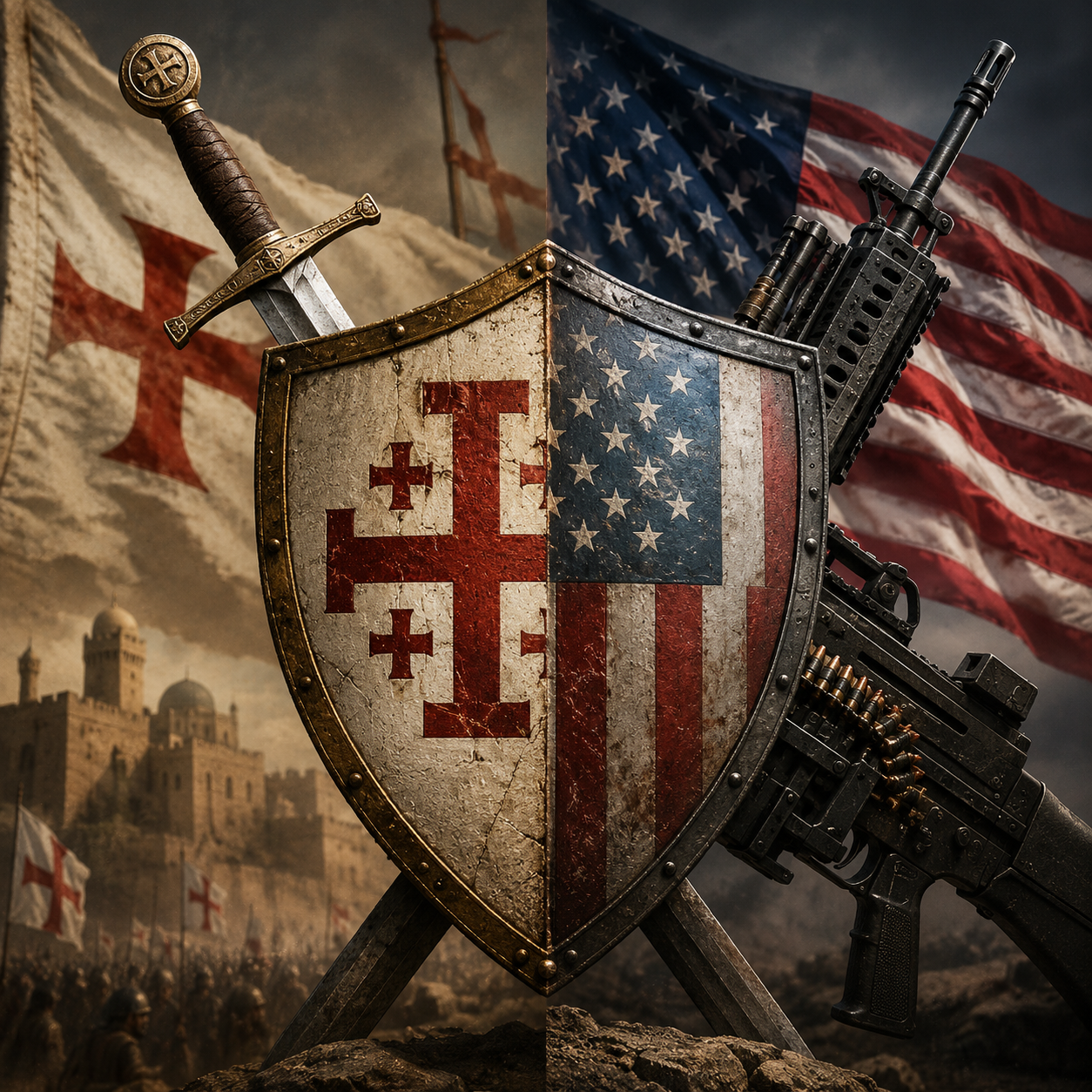
The era of Crusades never left the West. The language has changed but the beliefs remain the same. A desire to conquer Jerusalem, destroy the Muslim world and rule over the East is what sparked the 11th century Crusades. This belief has persisted in the modern day through the US-Israel led invasions of the Middle East that seeks to fulfil a Messianic prophecy. This article outlines how the Crusades are ongoing and how Europe’s mentality towards the Muslim world remains in the Middle Ages.
The Crusader Invasion of the East: Expansion, Plunder and Empire
The Crusades are often seen as a spiritual movement but were also born out of political and economic decline. In 1054, the Pope and Byzantine Emperor had excommunicated each other, leading to a diplomatic rift between the Christian kingdoms. The dispute, known as The Great Schism split the Western Latin Church from the East Orthodox Church. In addition, Europe was in financial hardship. A lack of resources, wealth and unemployment plunged the West into the Dark Ages. Its lands faced rampant disease, poverty and a collapsing feudal system which left citizens in squalor.
In the East, the Byzantine Empire was in decline. Their control over Anatolia had been undermined by the Seljuks, a Turkic dynasty which in the 11th century expanded rapidly into the Asia Minor. It was Sultan Alp Arslan who defeated the Byzantines in the battle of Manzikert in 1071, accelerating the loss of Anatolia. At the same time, the Sultanate of Rum, another Seljuk branch, threatened Byzantine control of the Asia Minor.
In 1095, Emperor Alexios Komnenos appealed to Pope Urban II for assistance to halt the Muslim expansion. The Pope had territorial ambitions of his own. He wanted to strengthen his papacy by re-establishing Christian control of Jerusalem. It was now under the control of the Fatimid Caliphate, who’d captured it from the Seljuks. Therefore the Byzantine-Papal alliance was formed. Grounded on a combined goal of military expansion, political ambition and religious zeal.
The First Crusade was announced at the Council of Clermont the same year. Pope Urban called on Western Europe to aid the Byzantines as a national security issue. He created a moral justification by invoking persecuted Christian pilgrims in Jerusalem:
“[The Turks] have violently invaded the lands of the Christians and depopulated them by pillage and fire.”
“The kingdom of the Greeks is now dismembered by them and has been deprived of territory so vast in extent that it could be traversed in two months' time.”
"Let hatred therefore depart from among you, let your quarrels end, let wars cease, and let all dissensions and controversies slumber. Enter upon the road to the Holy Sepulcher- wrest that land from the wicked race, and subject it to yourselves.”
The Pope used the Crusade to call for European unity. By ending internal fights amongst knights, nobles and peasants it would allow them to wage war in the East. This effort secured political aims by redirecting feudal violence toward external conquest. The Pope then described Jerusalem:
“That land which, as the Scripture says, `floweth with milk and honey' was given by God into the power of the children of Israel.
Jerusalem is the center of the earth; the land is fruitful above all others, like another paradise of delights.”
“This royal city, however, situated at the center of the earth, is now held captive by the enemies of Christ.”
By referencing the wealth of the East, its description appeals to impoverished knights and peasants dissatisfied with their economic and social status. They are provided both a religious mandate for conquest but also material wealth. This shows how warfare can be used by the state to serve broader political goals.
America’s Invasion of the Middle East: Warmongering, Opportunism and Oil
Using war to achieve political and economic interests is a long used tool by imperial powers. Just as the Crusades were driven by political ambition and conquest, the US' involvement in the Middle East was to acquire foreign resources and expand regional influence. In the 11th century, the Pope justified the First Crusade to protect Christian pilgrims in Jerusalem and depose the Seljuk Turks. Today, the US government invokes human rights concerns and oppressive Middle Eastern rulers.
In 2007, Alan Greenspan, former chairman of the Federal Reserve, claimed in his autobiography that the US had invaded Iraq to gain control over oil reserves. He wrote:
“I am saddened that it is politically inconvenient to acknowledge what everyone knows: the Iraq war is largely about oil."
"I thought the issue of weapons of mass destruction as the excuse was utterly beside the point.”
Greenspan clarified the US was threatened by Iraqi President Saddam Hussein who wanted to control the Strait of Hormuz. This would’ve affected Western control over oil shipments. Therefore invading Iraq had become paramount to US economic interests.
Shortly after 9/11, retired General Wesley Clark revealed that Pentagon officials had discussed plans to invade multiple Middle Eastern and North African states. He recalled the conversation:
“We’re going to take out seven countries in five years, starting with Iraq, and then Syria, Lebanon, Libya, Somalia, Sudan and, finishing off, Iran.”
In 2000, American neoconservatives argued in the policy paper Rebuilding America’s defences that the US needed to invade the Middle East for geopolitical expansion and maintaining hegemony:
“At present the United States faces no global rival. America’s grand strategy should aim to preserve and extend this advantageous position as far into the future as possible.”
The paper was commissioned by The Project for the New American Century, a Conservative non-profit established in 1997 which provides reports on how to protect America's global position. In the 2000 report their main concern was the 'decline in strength of America’s defenses' which would cause problems for ‘its leadership in the world.’
It outlines how America's new century goal is to pre-emptively defend itself against any rising power on the global stage. This is by neutralising any potential new great power competitor and preserving US dominance over Europe, East Asia and the Middle East. This strategic goal expands beyond a single regime or ruler. Concerning the Middle East they stated:
“The need for a substantial American force presence in the Gulf transcends the issue of the regime of Saddam Hussein.”
This shows how Iraq had been strategically important prior to the War on Terror, regardless of concerns over weapons of mass destruction. The main focus is to 'shape the international security order in line with American principles.’ This meant undermining any potential global power before it could rise. Whether it posed any real danger was irrelevant.
The report shows that imperial powers are not only focused on their domestic capabilities but hegemonic and global influence. This is similar to the Byzantine Emperor's concerns over the decline of its empire. The rise of Turkic power in Anatolia positioned the Muslims as a global competitor on the world stage. Therefore, Western forces invading the Asia Minor was essential to weaken rivals and preserve Byzantine dominance.
The Third Crusade: Holy War, Prophecy and Salvation
The Crusades had a deep epistemological core which united biblical prophecy with political objectives. During the First Crusade, the Pope named it an Armed Pilgrimage which united peasants and nobles alike, who were promised salvation and forgiveness by the Church. Mixing conquest with religious zeal became a powerful force which mobilised citizens.
This also extended to the European monarchy who conducted the Third Crusades to claim Jerusalem from the Muslims.
Christian religious zeal coupled with territorial ambitions is evidenced by a famous letter emerging in 1165, but influenced The Third Crusade decades later. It was a forged medieval document, supposedly written by a legendary Eastern monarch known as Prester John, the Indian King of Kings. It nonetheless captured the European imagination for conquests and religious warfare.
In the letter Prester John claimed to rule a vast and wealthy Christian empire in India (later believed to be Ethiopia). The monarch owned a wealthy kingdom of 72 kingships stretching from India to Babylon. He stated his soldiers would carry fifteen crosses made of gold and silver during war so that 'Jesus Christ may be brought back to our remembrance.’
Prester John also promised to provide military assistance if Jerusalem was invaded.
“We are likewise under vow to visit the sepulchre of our Lord with a great host, even as it befits the glory of our mightiness to subject and subdue the enemies of the Cross of Christ.”
‘The enemies of the Cross’ were interpreted to be the Seljuks, who’d originally controlled the Holy Land. Prester John’s letter gained immense popularity in medieval Europe, encouraging monarchs such as Germany’s Frederick Barbarossa and England’s Richard Lionheart to join the Crusades. Prester John’s legend represented Crusader hopes that Eastern Christians would help defeat the Muslim powers controlling Jerusalem.
European monarchs were captivated by the concept of united Christian rule over Eastern lands. The West hoped to establish permanent European control over the Islamic world. Prester John was a symbol of Christian power and potential: A King of Kings who could unite the East and the West.
By the 13th century, the Pope would order emissionaries and explorers in search of Prester John, entering India and Africa to find the legendary king. Overall, the Third Crusade captured the peak of religious Christian zeal. The Crusaders believed they could conquer Jerusalem to achieve divine salvation. Capturing the Holy Land would fulfil the Messianic prophecy to initiate the Second Coming of Jesus.
Modern Day Christian Zionism: The Rapture and The Judeo Christian Alliance
In the 21st century we are still overwhelmed with apocalyptic Christian discourse to acquire the Holy Land to achieve salvation. This is evidenced through modern Christian Zionism, championed by Evangelical Protestants who believe control of Jerusalem is central to Western identity. America was founded by British Puritan settlers who believed the Jews needed to be brought to the Holy Land. As a result, the US led global order is infused with a Crusader Spirit that equates Jerusalem with biblical prophecy.
Christian Zionism precedes Jewish Zionism. It developed in the latter half of the 17th and 18th centuries where Christian writers began to reflect on how Jesus would return. This led to the Pre-Millennial Dispensationalist movement who felt the Jews must return to the Holy Land to trigger the Second Coming of Christ. This was based on a reading of the Book of Revelation.
Christian Zionism has an extremely powerful base in the US. Its size and scope was mentioned by Pastor John Hagee, an American televangelist in a 2007 AIPAC speech:
“The sleeping giant of Christian Zionism has awakened; there are 50 million Christians standing up and applauding the State of Israel...The roots of Christianity are Jewish.”
(Hagee, 2007)
Christian Zionism’s influence also extends outside the Americas, reaching West Africa and parts of East Asia. The Evangelical base is the foundation of America’s relationship with Israel through the Judeo-Christian alliance: a movement which joins Jewish nationalism with Evangelical Christianity. This alliance shapes America’s foreign policy and allows Israel’s funded wars to expand its territory. Christian Zionists argue the Modern State of Israel must be supported to receive God’s blessing. Their main reference is a passage from Genesis where God speaks to Abraham:
“I will bless those who bless you, and whoever curses you I will curse”
Genesis 12:3
This is the rationale used by Evangelicals to protect the state of Israel, a belief followed by the current Trump administration. Notable figures such as Ted Cruz, Pete Hegseth and Trump’s spiritual advisor Paula White purport Christian Zionist beliefs to encourage wars in the Middle East.
The Early Crusades: Dehumanising Muslims To Justify Warfare
During the Crusades, opposition to Islam was not only framed as a political conflict but a sacred duty to fight corrupt heathens. Religious rhetoric deployed by the Christian nobility often centred around the language of dehumanisation. This was utilised in the Clermont Speech in which Pope Urban II framed the Muslims as a backward, heretical force:
“A race from the kingdom of the Persians, an accursed race, a race wholly alienated from God.”
This language involved religious fanaticism amongst the European population. It normalised wars against Muslims as a means to obtain religious salvation. It framed human rights disasters and war crimes as a sacred rite and duty, which united Europeans in a campaign of mass violence. This is evidenced by the massacre of Jerusalem in 1099 which Crusader chroniclers describe the gleeful massacres of thousands of Muslims inside the city.
Raymond of Aguilers wrote:
“In the Temple and porch of Solomon, men rode in blood up to their knees and bridle reins.”
Massacres of Muslims in Jerusalem alongside Christian Orthodox and Jewish populations were celebrated as divine sanctioned victories, demonstrating how religious rhetoric can normalise extreme violence.
This hostility extended towards Islam's symbols and Holy cities. In the 12th century, French Crusader Reynald of Châtillon launched raids toward the Red Sea, attempting to reach Makkah and Madina. Islamic scholars had feared he'd intended to desecrate the body of the Prophet ﷺ. Such actions reinforce that the Crusades were not simply defensive wars. They were part of a broader ideological struggle to dominate the Muslim world through religiously sanctioned violence.
The American Empire: Weaponising Democracy to Justify Massacres
Expressing hostility towards Islamic sites and symbols remains a feature of US foreign policy through its support of Israel. The destruction of Al Aqsa mosque has been a continued fear in the Muslim world as Israeli MPs have called for it to be levelled to build a Jewish Temple. The state has repeatedly banned Muslim worshippers in violation of an agreement with Jordan, the mosque's custodians.
Similar to Reynald of Châtillon's invasion of Islamic sites, the Greater Israel project is a military goal for Israel to extend its territory across Egypt, Iraq, Syria, Lebanon, Jordan and Saudi Arabia which holds Makkah and Medina. This vision is supported by the American political elite as a prophecy fulfilment. One such voice is Mike Huckabee, the US Ambassador to Israel and a Southern Baptist. He believes Israel owns all the land from the Nile to the Euphrates, stating in a 2026 Tucker Carlson interview: ‘It would be fine if they took it all'. The need for Zionism to dominate the centres of Islam showcases an epistemological goal to exert religious dominance over the Muslim world.
Like Pope Urban II framing Muslims as an evil race, the dehumanisation of Muslims reappear in contemporary rhetoric surrounding the Iran war and Israels' genocide in Gaza. In regards to Iran, US president Trump threatened that their ‘civilisation will die.’ IDF officials justified the levelling of Gaza by labelling Palestinians as ‘inhuman animals.'
In the contemporary age, the US doesn't just mirror the Crusades to shape its military strategy but directly invokes it to signify a Holy War. From George W Bush directly calling the War on Terror a 'Crusade' against Islamic fundamentalism. Cross insignia has been worn by US military personnel to symbolise religious warfare. Pete Hegseth, The Secretary of War, sports a Crusader tattoo and wrote in his book The American Crusade that warfare against Islam was a spiritual duty. The US possesses a modern day Crusader Complex which fuses violence with religious symbolism to attack the Islamic world.
The Pope once rallied Christians to support the Crusades, the Zionist Evangelical base now incites Holy Wars in the Middle East, framing the destruction of the Islamic world as a divine duty. During the Cold War, televangelists and preachers like Hal Lindsey famously interpreted passages from Ezekiel to claim Middle Eastern and Soviet powers were in a conflict against Israel Similarly, present day Evangelicals remain fervent supporters of Israel’s genocidal expansion in the Middle East to trigger the Second Coming.
The Crusader complex is largely associated with the far right neo-cons but the liberal mainstream media also deploys imperialist framings to normalise Middle Eastern invasions. The language of dehumanisation is shown in an infamous 1996 CBS interview with Madeleine Albright, a diplomat under the Clinton Administration. She was asked about the human cost of sanctions on Iraq:
Lesley Stahl: (CBS Journalist)
“We have heard that a half million children have died. I mean, that’s more children than died in Hiroshima. And, you know, is the price worth it?”
Madeleine Albright: “I think this is a very hard choice, but the price — we think the price is worth it.”
Albright’s response doesn’t just show casual dehumanisation - the fact that it was aired on television normalised genocidal statements. The US administration used collective punishment to destroy Saddam Hussein’s government through the Iraqi population. This turned them into human collateral to achieve geopolitical aims. This mirrors the early Crusades where the Byzantine-Papal alliance sought to depose the Seljuks and Fatimids, but leveraged Jerusalem’s population who were massacred in the process.
Conclusion
The Crusader spirit remains intact in the Western world - only the language and technology has changed. Violent pillages are now economic sanctions, conquered cities are now regime changes, and massacred populations become democratic liberation. Bombing Muslim lands means fighting Islamic fundamentalism.
The framing has changed but the ideology remains the same. The Crusades were motivated by territorial expansion and material gain, but hid itself under a religious cloak. Today, the US-Israel led imperial order rests on religious rhetoric and military force to achieve material and geopolitical objectives. Its epistemological foundation is powered by an End of Times belief that fuses hegemony with divine salvation. Despite being in the modern world, US hegemonic order rests on this medieval philosophy to achieve dominance.
Research Resources
JazakAllahu khair for reading. Please benefit the ummah by sharing this knowledge. Feel free to download this article for offline reading or consult the bibliography below.
-
Adams, R. (2007) ‘Invasion of Iraq was driven by oil, says Greenspan’, The Guardian, 17 September. Available at:https://www.theguardian.com/world/2007/sep/17/iraq.oil
Al Jazeera (2026) ‘What is “Greater Israel” and how popular is it among Israelis?’, Al Jazeera, 26 February. Available at:Al Jazeera article (Accessed: 19 May 2026).
CBS News (1996) ‘Madeleine Albright on Iraq sanctions (“We think the price is worth it”)’, YouTube video, uploaded by CBS News. Available at:YouTube video (Accessed: 19 May 2026).
Clark, W. (2007) Interview by A. Goodman on Democracy Now!, 2 March. Available at:https://www.democracynow.org/2007/3/2/gen_wesley_clark_weighs_presidential_bid (Accessed: 19 May 2026).
Gritten, D. (2026) ‘[Article title]’, BBC News, 7 April. Available at:BBC News article (Accessed: 19 May 2026).
John Hagee, speech at the American Israel Public Affairs Committee (AIPAC) Policy Conference, Washington DC, March 2007.
Kasim, S.L. (2023) ‘Israel’s former ambassador to UN calls Palestinians “inhuman animals”’, Anadolu Agency, 27 October. Updated 28 October 2023. Available at:Anadolu Agency article (Accessed: 19 May 2026).
Kagan, D., Schmitt, G. and Donnelly, T. (2000) Rebuilding America’s Defenses: Strategy, Forces and Resources for a New Century. Washington, DC: Project for the New American Century. Available at:https://resistir.info/livros/rebuilding_americas_defenses.pdf (Accessed: 19 May 2026).
Krey, August C. (trans.) (1921) The First Crusade: The Accounts of Eye-Witnesses and Participants. Princeton: Princeton University Press, p. 261. Available at: Internet Archive scanned edition (Accessed: 19 May 2026).
Masarwa, L. (2026) ‘Israel closes Al-Aqsa to Muslims amid mass settler raids and flag march’, Middle East Eye, 14 May. Available at:Middle East Eye article (Accessed: 19 May 2026).
Nieberg, P. (2025) ‘Marine investigated over Jerusalem cross patch photo’, Task & Purpose, 9 December. Available at:Task & Purpose article (Accessed: 19 May 2026).
Paul, I. (2024) ‘Hal Lindsey (1929–2024): The end-times theologian who popularised the rapture’, Premier Christianity, 13 December. Available at:Premier Christianity article (Accessed: 19 May 2026).
Perez-Rivas, M. (2001) ‘Bush: “This crusade, this war on terrorism, is going to take a while”’, CNN, 16 September. Available at:CNN article (Accessed: 19 May 2026).
Robinson, J.H. (ed.) (1904) Readings in European History. Vol. I. Boston: Ginn and Co., pp. 312–316. Available at: https://sourcebooks.web.fordham.edu/source/urban2a.asp
Solmaz, F.Z. (2026) ‘“It would be fine if they took it all,” US envoy says about Israeli biblical claims’, Anadolu Agency, 21 February. Updated 22 February 2026. Available at:Anadolu Agency article (Accessed: 19 May 2026).
Williams, R. (ed. and trans.) (1892) Selections from the Hengwrt MSS. Preserved in the Peniarth Library. London: Thomas Richards. Available at:https://www.maryjones.us/ctexts/presterjohn.html (Accessed: 19 May 2026).



The people of Shuʿayb were a nation destroyed for cheating in business. The cause of their downfall was viewing every interaction through the lens of profit. This led to extremes in how they treated others. Similarly, modern society has also become obsessed with profit margins over honest transactions.