

The Islamic Golden Age: How Faith Fuelled Innovation
بسم الله الرحمن الرحيم
In the Name of Allah, the Most Gracious the Most Merciful
The Golden Age was the peak of intellectual creativity. It produced famous figures like Ibn Sina, Al-Khwarizmi and Ibn al-Haytham. But the most important question is not what they achieved, but how Muslim societies could produce so many innovators in the first place. Creativity rarely emerges from isolated geniuses. We all have the capacity to learn, create and innovate, but the conditions must be right.
This is through society establishing institutions, incentives and a shared value system which produces talented people. This article looks at religiously driven knowledge production in the Abbasid Golden Age, and how it fuelled creativity.
Knowledge as a Religious Duty
Islam has always stressed the importance of seeking knowledge. This is the key to religious devotion, higher piety and a drive to reach excellence (ihsan) in all affairs. This is not driven by a desire for personal profit or glory, but religious salvation.
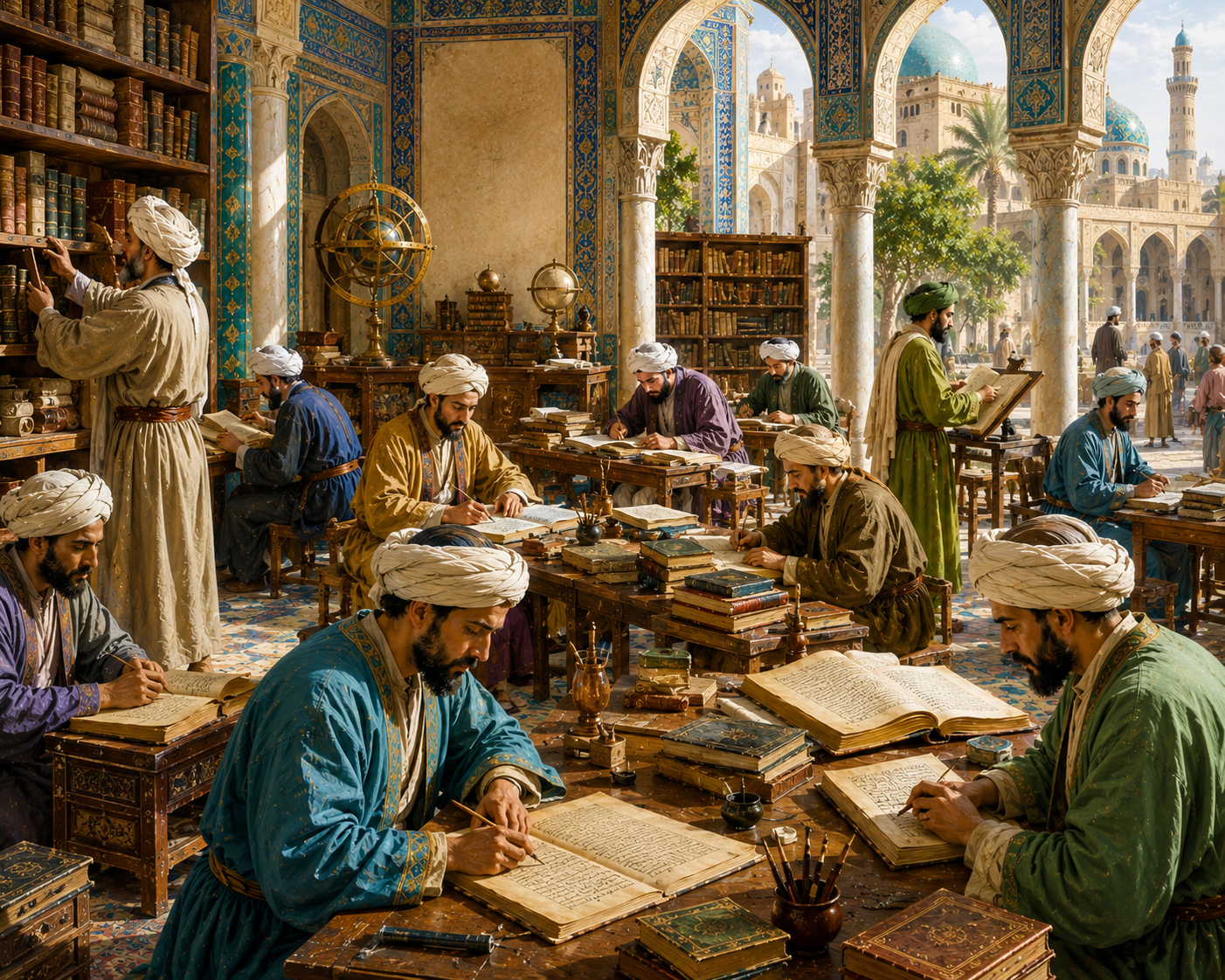
The Abassids were particularly interested in knowledge. When the new caliphate was formed, it absorbed the remainder of the Persian Empire who invested heavily in research. Gondishapur was a Persian learning institution with a teaching hospital, translation centre and library which was inherited by the Muslims. The Abassids immediately utilised it. They first constructed Baghdad, first known as Madinat al-Salam (City of Peace) and moved Gondishapur's books to what became the House of Wisdom during Al Ma'mun’s caliphate.
Similarly, the Abbasids collected Greek texts from the Byzantines who handed over old works of Plato and Aristotle, long abandoned by the Christian Empire. It was these works which greatly influenced the Islamic Golden Age. The new inward focus became learning, not just specifically to further Islamic sciences, but to reconcile different ideas with the Islamic creed.
This was the goal of philosophers like Al Kindi who argued Muslims could use non-Islamic sources for their research. This sentiment was continued under Al Farabi who translated and decoded Aristotle's text Metaphysics. Al Farabi's works then reached the famous scholar Ibn Sina, who used his predecessor's works to fuse Islamic knowledge with scientific rationalism and physics, later writing the famous book The Canon of Medicine.
The Golden Age produced islamic scholars and thinkers who learned to be intellectually brave. They absorbed new specialisms and ideas, wrestled with philosophy, astronomy, physics, alchemy, mathematics, and reconciled it with the Islamic sciences. It showed that subjects now considered to be secular were once a part of Islamic scholarship, working together to advance and create a stronger society. This highlights how knowledge production can unite intellectuals to further and improve an academic field, all driven by a faith based value system which encourages them to become intellectually driven.
The Abbasid caliphate provided the perfect environment to learn because it embraced the best of multiple civilisations and brought them together in harmony. It was the Persian culture of learning, philosophy from the Greeks, mathematics from the Hindus which united with Arab thinkers and Islamic scholarship to create a knowledge explosion, bringing forth new, revolutionary ideas.
Development of Research Centres
Access to knowledge must always be prioritised. In order for a society to be free thinking, develop their own ideas, they must be able to access books, translate works, conduct research and form their own conclusions. This took place in 832 when Caliph Al Ma'mun opened the House of Wisdom (Baytul Hikmah). It was a research institute, library, translation centre and university. This is where people from any race and religion come to learn. Scholars from all over the world flocked to Baghdad to study there.
Most importantly, the House of Wisdom was government funded. Students did not need to pay tuition fees, incur personal costs and financial difficulties in accessing knowledge. All books, translation materials and personal study spaces were provided for learners. The government personally funded Greek texts to be translated into multiple languages. The House of Wisdom's success can be shown through Muslim advancements in science, technology, maths, social studies, fiqh and hadith. (AlKhateeb, 2017, 88-90)
This was crucial to creating a unified society with shared values of learning, innovation and public service. Scholars cannot be produced if people do not have access to learning spaces and materials. Every citizen of the empire and those travelling from Europe were welcome to study at the House of Wisdom.
It shows that all people have the capacity to learn, but knowledge centres have to be funded by institutions and not shouldered by the public. Accessibility to learning is what unites the best and brightest to seek knowledge, in return they will invest back into society through their scholarly achievements.
Patronage and the Freedom to Think
Creativity was only possible by funding men of learning. Scholars used to have time to sit and think, research and find solutions to the problems in the Muslim world. In order to devote themselves to research, they need to be relieved from financial constraints.
The Islamic caliphate developed a sophisticated patronage system in which governors, caliphs and Viziers funded intellectuals, scholars and scientists to write, research, translate or serve in government. This was notable during the Abbasid era which funded many famous academics. Imam Malik had time to write and teach because he was funded. Imam al Bukhari traveled for hadith compilation because his travel expenses were covered.
Ibn Sina had patrons who allowed him to study and advance the medical field. The patronage system allowed Al Khawarzmi to invent algebra to solve zakat problems. Government funded research gave Al Kindi the opportunity to travel to Gondishapur and study Greek philosophy. This was all because of patronage.
Harun al Rashid’s caliphate was known for sponsoring men of learning and science. Translators, commentators and poets could receive funding by dignitaries in his court. Caliph Harun even sent a delegation to Byzantium to obtain Greek texts for translation into Arabic and Syriac. His Vizier Yahya the Barmakid imported doctors and philosophers from India, and ‘protected anyone who might contribute to the advance of learning.’
At the request of Caliph Harun, the Siddhartta, a fifth century Indian text on astronomy was translated, alongside Euclid’sElements and Ptolemy’s Almagest. Additionally, al-Rashid’s son Al Ma’mun would also send messengers to Constantinople requesting Aristotle’s complete works. (Clot, 1989, 209-10)
Nurturing Talent from a Young Age
The early Islamic societies were characterised by how they treated knowledge seekers. Muslim youths studied Islamic sciences under scholars. For those who excelled, they were singled out for their potential. This was Imam Al Bukhari’s experience who at 11 years old was identified for his ability to recall long hadith chains. This talent was exposed in an incident with his teacher Imam al-Dakhili, where he famously corrected the scholar for making a mistake in a lengthy chain. After checking his notes, Imam al-Dakhili realised the boy was correct. After that, he would pay special attention to the young student. This showed how teachers took gifted students seriously rather than dismissing them because of their age. (Janobiddinov, 2025)
Ibn Sina also gained academic training at a young age in which he memorised the Quran by six and was taught Islamic sciences. Noticing his potential, Ibn Sina’s father Abdullah, a local leader, had his son tutored by Al Natili, a philosopher who was visiting Bukhara. He also noticed Ibn Sina’s strong comprehension of rationality and the sciences as a teenager. Since Al Natili was also a practising physician, he taught the boy the foundational knowledge of the trade. Ibn Sina later mastered this science and started to practice medicine at 16 years old. He described the response to his talents:
Distinguished physicians began to read the science of medicine under me. I cared for the sick and there opened to me some of the doors of medical treatment…at that time being sixteen years old.
(Ibn Sina, 1974, 23)
Notably, Ibn Sina mastered his craft through mentoring. His exposure to specialist tutors was because he showed promise and potential, constantly exceeding expectations. With Al Natili he both studied the sciences and worked practically in the field. He observed how patients were treated and studied in his spare time to eventually develop his knowledge further. This bolstered Ibn Sina's ability to be intellectually brave. By 17 years old, he was valued enough to work for Bukhara’s governor Nur ibn Mansour as his personal physician.
This was only possible through youth mentorship and close supervision under a more experienced teacher. He was exposed to new intellectual challenges and mastered every task he was handed, in which he was rewarded with further opportunities. It proves all human beings are born with a capacity to learn. All we need is a mentor, who believes in our ability to succeed. A student also needs to be open minded, and be able to adapt to challenges and embrace new opportunities with a desire to excel and learn. It shows that both the mentor and the student themselves have unique roles to play in fostering an environment of creative learning and intellectual brilliance.
Conclusion: Reviving Knowledge and Creativity
The Islamic Golden Age was an age of creativity and peak innovation. It was unique to its time, but capturing its essence in the modern world means mastering the techniques and processes which produced this age of learning to begin with. The core was always religious devotion. Caliphs, viziers and governors spent vast sums of wealth funding public hospitals, charities and private scholars not to earn a profit but seeking Allah's pleasure.
Scholars were funded not to enhance their fame but produce works to solve societal problems and contribute to scholarship and academia. Intellectuals themselves mentored promising young learners, not as a means of prestige but to produce future thinkers who will surpass them.
The Golden Age was characterised by the selflessness, charitable endeavours and the intellectual lengths individuals went to pass on an enduring value system; a love of knowledge. The Abbasid caliphate brought together civilisations, people and intellectual traditions to produce a perfect blend of driven and creative individuals, who invested in one another to bring about their intellectual brilliance. It shows that societal creativity can only be furthered when unified by a moral and religious vision. This will allow us to fund scholars, research institutions and charitable pursuits. When religion reunites with knowledge production, it will produce the best of society, just like that experienced in the Golden Age.
Research Resources
JazakAllahu khair for reading. Please benefit the ummah by sharing this knowledge. Feel free to download this article for offline reading or consult the bibliography below.
-
Alkhateeb, F. (2017) Lost Islamic History: Reclaiming Muslim Civilisation from the Past. Revised 2nd edn. London: C. Hurst & Co. Publishers Ltd.
Clot, A. (1989) Harun al-Rashid and the World of the Thousand and One Nights. Translated by J. Howe. New York: New Amsterdam Books.
Ibn Sina (1974) The Life of Ibn Sina: A Critical Edition and Annotated Translation. Translated by W.E. Gohlman. 1st edn. Albany, NY: State University of New York Press (Studies in Islamic Philosophy and Science).
Janobiddinov, A. (2025) Imam al-Bukhari: preserving the prophetic teachings. Meer, 10 March. Available at:Meer (Accessed: 24 June 2026).


Imam Abu Hanifa رَحِمَهُ ٱللَّٰهُ was a pioneer of fiqh—but he did not begin his life as a scholar. He was a wealthy merchant who, after being encouraged by a scholar to pursue knowledge, transformed the field of fiqh. Known for his piety, generosity and resilience against oppressive rulers, his timeless legacy has shaped Islamic scholarship.