

بسم الله الرحمن الرحيم
In the Name of Allah, the Most Gracious the Most Merciful
We’re living in an age of global anarchy. One where the farce of American democracy has been exposed.
Under the Trump administration, America’s shift into totalitarianism is evident. At home, ICE terrorises immigrant communities, Pro-Palestinian activists are targeted while tax payer dollars continue to fund the Israeli terror state. While abroad, the invasion of Venezuela and the genocide in Gaza, alongside the escalating violence in the Middle East, threaten to spark a regional war.
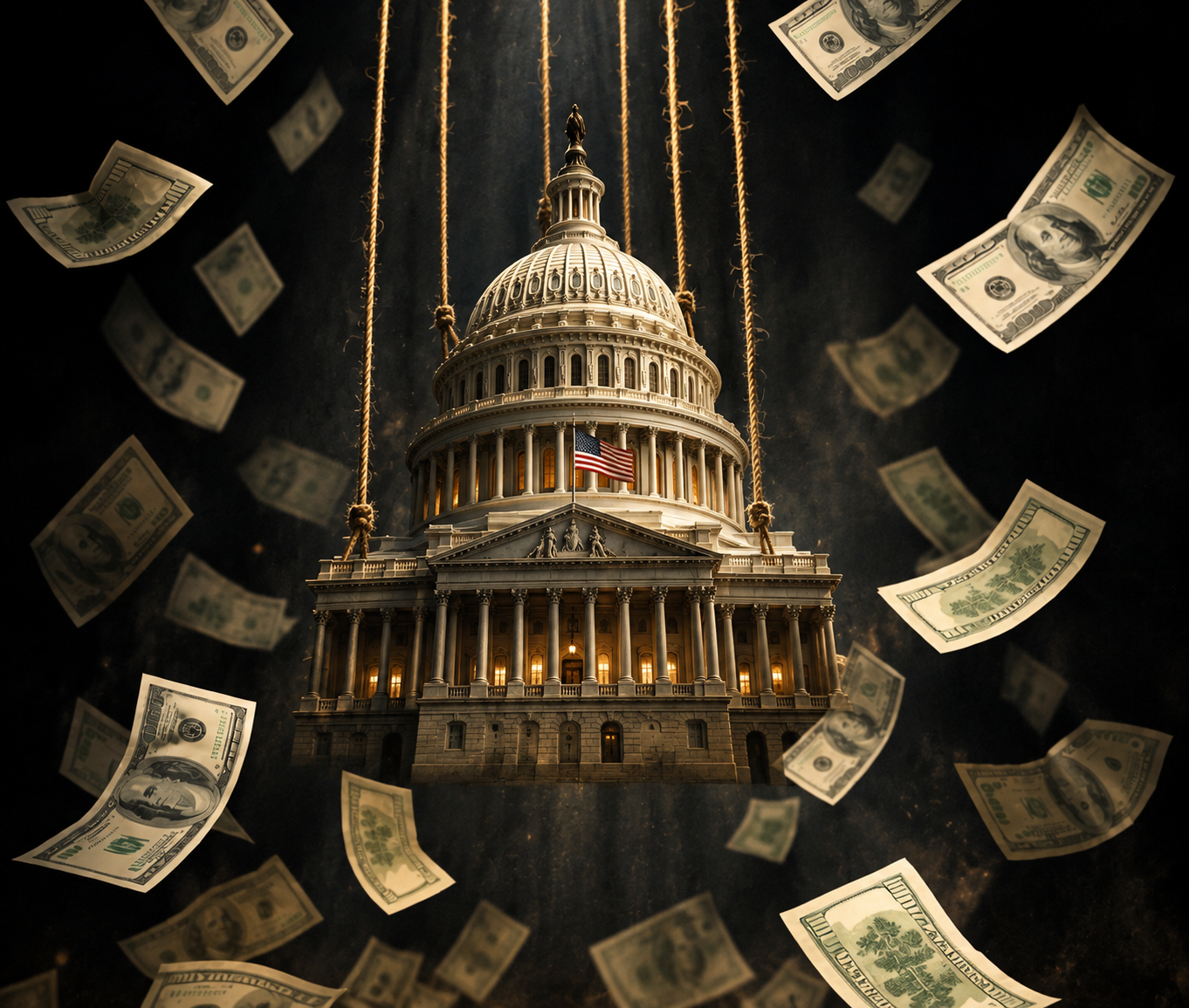
America did not collapse under one leader. It exposed an empire organised around money, operating beyond electoral cycles. This mindset is built into its institutions and enforced by elites driven by material gain.
This stresses a need to understand how power really works in Western democracies. Power dynamics shape who can influence others, through lobbying, elections, or force.
This article explores the power dynamics in the American government, the objectives of its elites, and how their influence reaches every corner of society — and how citizens can respond.
Corporate Elites: The Unelected Power Players
In a capitalist society, real power is in the hands of those who control money. Financial capital shapes which ideas are taken seriously, which policies move forward, and who gets access to decision-makers.
Wealth does not just buy influence behind the scenes; it also creates authority in public life. As sociologist C. Wright Mills put it:
“Prestige is the shadow of money and power.”
(Mills, 1956, 86).
Those with money are more likely to be seen as credible, important, and worth listening to. Understanding power, then, begins with understanding who controls capital. Those who control money form the elite class. In The Power Elite, C. Wright Mills describes them as powerful men and women who command major institutions and hierarchies. They occupy high levels within the social structure.
They are not just isolated rulers. The elite class are ‘advisors, consultants, spokesmen and opinion-makers’ with high decision making powers. They could be the head editor of a news company, business leader, head of a think tank or high ranking military general. These individuals meet in high level summits and discuss ways to enact policies on a global scale. (Mills, 1956, 4-6).
The Corporate Economy
The elites run a corporate economy, in which they constantly search for more ways to make money. The military needs more funding to create new wars and acquire resources from other lands. Tech billionaires lobby governments to utilise their technology and AI tools to profit from state surveillance. Media and entertainment companies focus on expanding their market share by appeasing the political establishment. This all requires financial power which fuels the goals of the elite.
How this control is established is significant. In a traditional dictatorship, a powerful ruler directly controls its population through state force and repression. Western nations exert control over their systems using it indirectly to influence its population.
This is by intervening in all parts of society such as family, education, politics, bureaucracy and culture to ensure they support the interests of the state. Through capitalism, society is transformed to run like a giant corporation. Every aspect of the state is then built around making money - universities, schools and hospitals become businesses. Their goal is centred on maximising wealth for its shareholders.
The elite class is disinterested in morality or ethics and how their policies affect the wider population. They are purely motivated by financial gain, material acquisition and cost effectiveness. (Wolin, 2008, 158-161)
Politicians: The Controlled Middle Manager
In a Western democracy, political power is presented as resting with citizens, who participate in elections every three to five years. During each election cycle, politicians campaign for a mandate. They publish manifestos, seek public donations, and are promoted by the media as rising stars or safe establishment choices. Once elected, their authority appears to rest on public approval of the policies they promise to deliver, whether tax cuts, increased social spending, or reform.
In reality, politicians do not have direct power to distribute resources. No single official owns the money they pay out, the buildings, tools and war machines they control. Politicians, civil servants and officials work within offices, managing assets and decisions that ultimately remain beyond their personal control. This means that if politicians do not own the machinery they govern, power is then held within the offices, producers and institutions - not individuals.
When a politician makes election promises, they still depend on the flexibility of the institution they serve. If the bureaucracy rejects their vision for change, these electoral promises are either abandoned or refined to exist within the power structure. (Weber, 1919, 7-45)
If politicians are constrained by bureaucracy, then which groups affect policy formation?
One of the largest sources of political power comes from lobby groups, which exert significant control within the political system.
Lobbies exist to influence decisions made by government officials and represent a wide range of interests, including corporations, NGOs, trade associations, and grassroots movements.
Their influence is often reinforced through campaign contributions, where large sums of money are donated to politicians.
In America, one of the most powerful lobby groups is AIPAC, a Pro-Zionist lobby, which has financed the careers of senior politicians. According to TrackAIPAC, US president Donald Trump received over $23 million in donations from pro-Israel institutions, and even private individuals such as Miriam Adelson, a wealthy Israeli donor.
Adelson leads the Preserve America PAC that helped Trump’s re-election in 2024. Her lobbying also affected Trump’s decision to move the capital of Jerusalem to Israel.
Politicians who refuse to support pro-Israeli lobbies will have limited reach in government, creating a system dependent on pro-Zionist loyalties.
In 2024, Democrat Cori Bush lost her re-election to Zionist opponent Wesley Bell in St Louis, Missouri. Bush became the target of Pro-Israel groups after criticising Israel’s continued genocide in Gaza.
In addition to this, AIPAC was instrumental in unseating New York congressman Jamaal Bowman over similar criticisms. This was part of a coordinated lobbying campaign worth millions to target anti-Zionist voices.
This shows how money can be used to influence and silence politicians on the basis of personal views, and how morals hold little value in the political space. If one doesn’t submit to approved elite sponsored interests, they are vulnerable to lobbies who can weaponise spending power to oust them. As a result, money controls a politician's career - far more than an electoral mandate.
Economic Activism: Restoring Power back to the People
To conclude, the language of money is integral to understanding power dynamics in the Western world. Policies are shaped around material acquisition, led by lobbyists and private companies who influence public officials to support their financial projects. This leaves out the public, who hold little influence in the halls of power.
Western democracy has narrowed the ways in which the public can express political will, largely limiting it to elections. However there is a better route, which allows citizens to reclaim political power for themselves. This is through economic activism, which harnesses the value of money to bolster influence.
As the general public does not have the wealth to control institutions or lobby elected officials, they need to disrupt the elite’s flow of money. This involves attacking arms factories manufacturing weapons for genocide, boycotting Zionist businesses but also finding new ways to disrupt corporate decisions which undermine the public interest.
Economic activism must extend to protecting small businesses, the environment and preventing gentrification in local neighbourhoods. It’s part of an interconnected movement which targets capitalist greed that undermines the public’s quality of life.
For example, Google and Amazon have built data centres across the US - consuming high amounts of water and electricity. All of which burden local residents with increased household bills.
It’s a citizen’s duty to disrupt, attack and limit access to these centres, leading to the loss of revenue. If it becomes costly to maintain data centres and protect them from harm, it dissuades corporations from building any more, or be forced to incur charges to safeguard them. The goal is to pressure corporations into developing public awareness by fearing coordinated resistance to unpopular business decisions.
Economic activism is arguably one of the best forms of resistance but must be organised through attacking sources of corporate wealth. When the public understands where power lies, it transfers legitimacy from the elites to the group who utilises it best.
We live in an age of technological innovation where AI, algorithms, and high speed internet allow easy access to information. The same way we're taught to problem solve, fix and create solutions in our jobs, the same level of vigour must be exerted in developing new forms of political power. This must be outside the limitations of electoral participation. When economic activism moves into the mainstream, it can compel the system to take public demands seriously.
And it’s all achieved by speaking the same language - money.
May Allah inspire the ummah to be more politically aware, defend public interests and always strive to deliver justice.
Research Resources
JazakAllahu khair for reading. Please benefit the ummah by sharing this knowledge. Feel free to download this article for offline reading or consult the bibliography below.
-
Debusmann Jr, B. (2024) Jamaal Bowman loses most expensive primary race ever, BBC News, 26 June. Available at: https://www.bbc.co.uk/news/articles/cz99x0w65dyo
Foster, J. (2024) How does lobbying affect the government? LegiStorm Blog. Available at: https://info.legistorm.com/blog/how-does-lobbying-affect-the-government
Goller, H. (2025) Trump salutes mega donor Miriam Adelson for help shaping US decisions on Israel, Reuters, 13 October. Available at: https://www.reuters.com/world/us/trump-salutes-mega-donor-miriam-adelson-help-shaping-us-decisions-israel-2025-10-13/
Mansoor, S. (2025) Democratic senators investigate data centres’ effects on electricity prices, The Guardian, 16 December. Available at: https://www.theguardian.com/us-news/2025/dec/16/data-centers-consumer-prices
McGreal, C. (2024) Cori Bush loses primary after pro-Israel groups spend millions to oust ‘Squad’ member, The Guardian, 6 August. Available at: https://www.theguardian.com/us-news/article/2024/aug/06/missouri-cori-bush-primary-bell-aipac-israel
Mills, C. Wright. 1956 [1970] The Power Elite. New York: Oxford University Press.Track AIPAC The Trump Administration — Track AIPAC. Available at: https://www.trackaipac.com/trump
Wolin, Sheldon S. 2008, Democracy incorporated : managed democracy and the specter of inverted totalitarianism, Princeton University Press, volume 5, Paperback ISBN: 978-0-691-14589-1
Weber, M. (1919/1946) Politics as a vocation. Translated and edited by H.H. Gerth & C. Wright Mills. New York: Oxford University Press
Continue Exploring


Abu Lahab was a staunch enemy of Prophet Muhammad ﷺ from the moment he called Quraiysh to Islam. Abu Lahab was a wealthy businessman, whose materialistic worldview caused him to value money over religion. This mindset remains prevalent in contemporary capitalist society. Billionaires devote their lives to accumulating wealth and status, believing that death can be delayed and money shields from divine accountability.