

Piety, Generosity and God-Consciousness: The Character of Harun al-Rashid

بسم الله الرحمن الرحيم
In the Name of Allah, the Most Gracious the Most Merciful
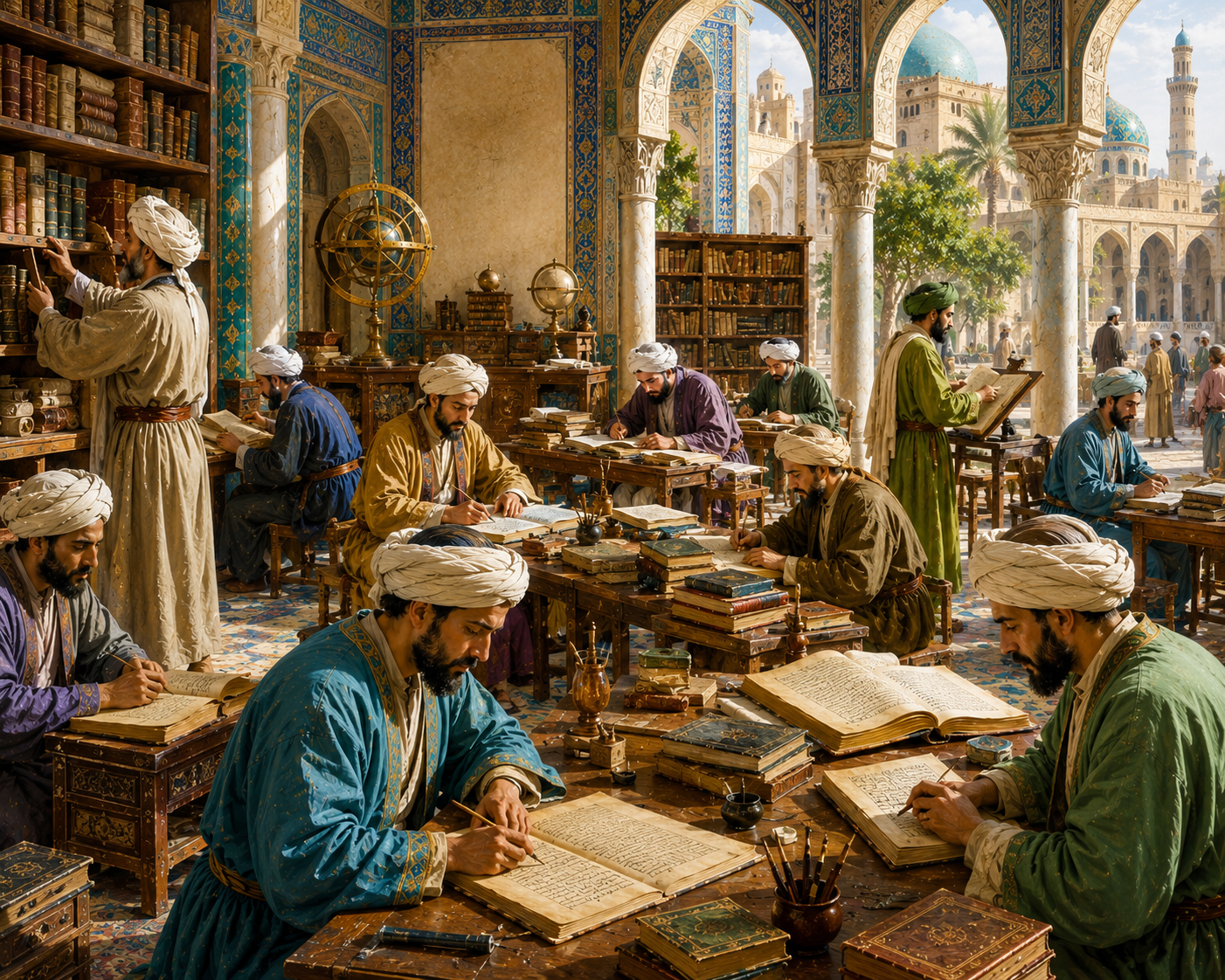
Harun al Rashid was known as the Caliph of the Golden Age, whose name is immortalised in legend and historical folklore. However, his personal piety and character is not as commonly depicted.
This article focuses on personal stories of al Rashid outside of his leadership, outlining his piety, worship and treatment of scholars. For Harun al-Rashid's early life, political career and major historical events, read Harun al Rashid: The Caliph of the Golden Age.
Personal Piety
Al-Dhahabi describes the personal piety of Harun al Rashid, depicting him as a noble and modest caliph, who frequently embarked on Hajj, fought in the way of Allah and possessed courage and good opinion. He then describes his most venerable traits:
It was said that he used to pray one hundred rak'ahs every day during his caliphate until he died, and he gave charity with a thousand, and he loved the scholars, he exalted the sanctity of religion, he hated arguments and speech, and he wept over himself, his amusement and his sins, especially if he preached.
Abu Muʿawiyah al-Darir said: “Whenever I mentioned the Prophet ﷺ in the presence of al-Rashid, he would say, ‘May Allah bless my master.’ When I mentioned the Prophet’s words, ‘I wish that I could fight in the cause of Allah, be killed, then brought back to life and killed again,’ al-Rashid wept until he sobbed.”
(Al-Dhahabi, 1985, 287-8)
Reverence for Knowledge and Scholars
During Harun al Rashid's time, the Islamic world had become a multi-continental blend of nations, cultures and contrasting opinions and movements. Philosophy was translated from Syriac, Greek and other languages. There were also conflicts of political disunity, alongside intellectual deviations within Islam. While al Mansur and al-Mahdi's reign had been focused on curbing rebellions and insurrections, al-Rashid wanted to unite people through the ulamah (scholars).
He brought scholars close to him and gave them prominent positions in his government. It was during his time where the science of fiqh, hadith and its teachers had great standing. (Abu Zahra, 1999, 265)
This is shown by Caliph Harun honouring Imam Malik ibn Anas when seeking consultation from him:
Abu Nu‘aym transmitted in al-Hilya that ‘Abdullah ibn ‘Abdu’l-Hakam said:
“I heard Malik ibn Anas say, ‘Harun ar-Rashid consulted me about three things: whether the Muwatta’ (Imam Malik’s foundational work) should be hung in the Ka‘ba and people be compelled to follow what it contains; whether the minbar of the Prophet, may Allah bless him and grant him peace, should be dismantled and rebuilt with jewels and gold and silver; and whether Nafi‘ ibn Abi Nu‘aym should be made Imam to lead the people in prayer in the mosque of the Messenger of Allah.
I replied, ‘Amir al-Mu’minin, as for hanging the Muwatta’ in the Ka‘ba, the Companions of the Messenger of Allah disagreed about the branches of knowledge. They dispersed throughout the lands of Islam and each one did what he thought correct.
As for dismantling the minbar, I do not think that you should deny people the relics of the Messenger of Allah. As for promoting Nafi‘ to lead the people in the prayer, Nafi‘ is an Imam in recitation and he is not safe from making a mistake in the mihrab, so protect him.’
Harun said, ‘May Allah give you success, Abu ‘Abdullah!’”
(Abu Zahra, 1999, 77)
Caliph Harun consulting with Imam Malik over religious matters and accepting the ruling shows not only a reverence but a desire to create harmony within the Islamic community, ensuring the correct guidelines are followed.
The caliph was also taught there was a difference amongst people of knowledge and there were many ways to interpret matters. This showcases the standing of Imam Malik that he was able to advise the caliph personally, highlighting their close relationship.
Defending the Honour of the Prophet ﷺ
Harun al Rashid venerated hadith, and considered anyone who attacked the Messenger of Allah ﷺ to be a heretic. He once jailed a relative who he believed to have been expressing skepticism or mockery towards a hadith in a discussion circle. The incident was as follows:
Imam Ya‘qub ibn Sufyan al-Farisi said: I heard ‘Ali ibn al-Madini say: Muhammad ibn Khazim (Abu Mu‘awiyah) stated:
I was reciting the Hadiths of Sulayman ibn Mihran al-A‘mash, which he narrated from Abu Salih (who narrated from Abu Hurairah, from the Messenger of Allah صلى الله عليه وسلم) in the presence of Amir al-Mu’minin Harun (al-Rashid).
Until I narrated the Hadith about the meeting of Adam and Musa (علیہما السلام), in which the issue of predestination (Qadr) is established.
The Prophet (ﷺ) said, "Moses argued with Adam and said to him (Adam), 'You are the one who got the people out of Paradise by your sin, and thus made them miserable."
Adam replied, 'O Moses! You are the one whom Allah selected for His Message and for His direct talk. Yet you blame me for a thing which Allah had ordained for me before He created me?." Allah's Messenger (ﷺ) further said, "So Adam overcame Moses by this Argument.”
At that point, an uncle of Harun al-Rashid raised a skeptical or mocking question objecting to the hadith, asking:
“Where did this meeting between Adam and Musa (علیہما السلام) take place?”
Hearing this, Harun al-Rashid became intensely angry and said:
“The Prophet (ﷺ) says they met, and you ask ‘Where did they meet?!’ Bring me a sword and leather mat (execution mat); he is a heretic/deviant (zindiq)!”
The attendees and scholars pleaded with the Caliph, explaining that the man was ignorant, not a heretic or an apostate. Harun al-Rashid then ordered the man to be imprisoned until he repented and showed genuine remorse for questioning prophetic tradition with insolence.
Later, this uncle summoned me (Abu Mu‘awiyah) to prison and said, “By Allah, no one told me to say this; the words just slipped out of my mouth.” I went back and informed Amir al-Mu’minin (Harun al-Rashid) that it was merely a slip of the tongue and that no one had told him to say it. So he ordered his release and said:
“I had thought that some heretical atheists (mulhid and zindiq) had taught him this statement. If I were to find out who these atheists are, I would have them killed. However, I am confident that my Qurayshi relative could not possibly be a zindiq.”
(al-Fasawī 1981, cited in Monthly Al-Hadith).
The incident showed Harun al-Rashid’s love of hadith and respect for the Messenger of Allah ﷺ. He had perceived his uncle’s response as an expression of skepticism, rejection and mockery of an authentic hadith, worrying that heretics had entered his court. This faith inspiring event portrays al Rashid as someone who defended hadith against those who undermine it.
Accepting Admonition
Harun al Rashid was forbearing with scholars who would admonish him and rectify his mistakes and remind him of Allah. After the Rashidun caliphate, rulers became flawed and would not always follow the Islamic way in every circumstance. However, al-Rashid maintained a relationship with scholars who advised him on matters and corrected his wrongdoings. As shown in one instance:
[Imam Malik] said to Harun ar-Rashid: “It has been reported to me that ‘Umar ibn al-Khattab, in spite of his excellence and position, would blow for people on the ashes of the fire under the pots until smoke came from his beard. People are pleased with you doing less than that.”
(Abu Zahra, 1999, 265)
Similarly, Caliph Harun also accepted being reminded of his duties as a caliph, and the enormous responsibility to protect and guard his subjects. This is clear when Abu Yusuf, the chief justice of Harun al Rashid was commissioned to write a book called Taxation in Islam.
The Qadi (Judge) specifically pointed out the project was at the behest of Caliph Harun, showing his commitment to religious matters. Abu Yusuf mentions the caliph in his work:
“The Commander of the Faithful, may Allah strengthen him, has requested me to compose for him a comprehensive book, to be used for the purposes of the collection of the kharaj taxes.”
A book for him to study and act upon, designed to avert oppression from his subjects and to benefit their interests.
I recommend to you, O Commander of the Faithful, to take care of what Allah has assigned to your care and to guard what He has entrusted to your rule, to pay no heed in these matters except to Him, and to rely only on Him.
(Abu Yusuf, 1969, 35-37)
It shows Harun al Rashid wanted to be held accountable, as commissioning the book showcases a keenness to protect the affairs of the Muslims, serve them dutifully and uphold their religious rights. The ability of Abu Yusuf to advise the caliph to fear Allah in his affairs and remember the weight of his duty reflects the mentality of a ruler who welcomes the ability to be scrutinised by his judges and subjects. This ensured he was reminded of the weight of responsibility, highlighting personal introspection and self awareness.
Respecting the Ka‘ba
Throughout history the Ka‘ba has been rebuilt and restructured. At times due to natural disasters such as floods or fires, in which Quraysh rebuilt the Sacred House. Another instance was after the Second Fitnah in which it was burnt down, this is attributed to Ibn al Zubair's uprising against the Umayyads, who decided to restore it and added a gate. However, after his murder by Hajjaj ibn Yusuf, the structure was allegedly reverted to its original Qurayshi model.
When Harun al Rashid wished to reconstruct the Ka‘ba again he also sought the legal opinion of Imam Malik who told him:
By God, may I urge you not to make this sacred house a ‘plaything for kings’. None of them wants to do anything else than tear it down and rebuild it. If the kings persist on the act of reconstruction, the respect for the house will fade away from the hearts of people.
(Chenganakkattil, 2024, 317-319)
The fact that Caliph Harun did not alter the Ka‘ba after this demonstrates his reverence for the scholars and his refusal to place political ambitions above its sanctity, preserving its honour in Islamic history and the Muslim memory.
Willingness to Learn from Mistakes
As mentioned, Harun al Rashid valued the opinion of people of knowledge, particularly the faqih and people of hadith. He also turned to them to help settle internal disputes and mediate personal matters. One of these scholars was Imam Abu Yusuf, his chief justice who was summoned after Caliph Harun quarrelled with his wife Zubaidah bint Jafar.
During the argument, the caliph had ordered her to leave his kingdom by the end of the night or she was divorced. He later regretted his decision and wanted to remain married, however if Zubaidah didn’t exit his expansive caliphate overnight the divorce would take place. He first turned to other scholars who couldn’t resolve the matter.
He then called Abu Yusuf and asked whether there was a way out of the situation. He replied, “Yes.” They waited to hear his answer:
“Let her spend the night in the mosque, for the mosque is not part of his kingdom,” and he cited Allah's words in Surah Jinn:
The places of worship are ˹only˺ for Allah, so do not invoke anyone besides Him.
He advised Caliph Harun that his wife should sleep in the masjid as it is the kingdom of Allah. As a result, Zubaidah remained there overnight where she spent the night in prayer to Allah, before she returned home the next day, cancelling out the divorce condition. (Abu Khalil, 2006,153–154)
The incident taught Caliph Harun not to be hasty in giving oaths and showed his willingness to follow religious guidance after committing mistakes. Additionally, the incident highlighted the talent of Imam Abu Yusuf and Caliph Harun’s selection of him. The caliph greatly valued his chief justice and even led his funeral prayer after Abu Yusuf passed away at 69 years old. He was laid to rest in the family cemetery.
Concern About Death
Caliph Harun al Rashid ruled vast territories, having access to the world’s riches. He famously said to the clouds: “Rain anywhere else you desire. By Allah you will not rain upon any land but it shall fall under our sway.”
Despite his enormous wealth, he was conscious of the Day of Judgement and the conditions of the grave. One day he went on a hunting expedition and met a man called Buhul. He said:
“Admonish me, O Buhul.”
The man asked: “O Commander of the Faithful, where are you fathers and grandfathers, starting from Allah’s Messenger up until your father?”
Harun replied: “They are dead.”
Buhul then asked. “Where are there palaces and graves?”
Harun pointed in its direction.“How have their palaces benefited in their graves?”
Buhul then delivered lines of poetry.
“Consider the expanse of your place in the world.
Would that your grave after death is more expansive.
If you set about to amass the treasures of Caesar
And if you live for many years, then what?
Isn’t the grave the end of every living?
And won’t you be queried afterwards concerning all these?Caliph Harun said “Certainly.”
He later returned home, and fell ill after a few days. Weeping, he gathered his armies and made a dua to Allah:
“O One Whose kingdom does not terminate, have mercy on the one whose kingdom has come to an end.”
(Al Areefi, 2016, 52-3)
Conclusion
Overall, Harun al Rashid was a caliph who was governed by personal piety and self reflection. Despite the luxury and riches his kingdom possessed, countless stories evidence his love of scholars, desire to be held accountable, veneration for fiqh and hadith and personal piety. In regards to his character, it evidences a legacy of faith and God-consciousness.
May Allah have mercy on Caliph Harun al Rashid, forgive his mistakes and allow us to learn from his personal legacy of piety and God-consciousness.
For Harun al-Rashid's life, political career and major historical events, read the full biography: Harun al Rashid: The Caliph of the Golden Age as featured below.
Research Resources
JazakAllahu khair for reading. Please benefit the ummah by sharing this knowledge. Feel free to download this article for offline reading or consult the bibliography below.
-
Al-Areefi, M.A.-R. (2016) The Last World: Description of the Signs of the Hour, Barzakh and the Hereafter from Qur'an and Sunnah. Riyadh: Darussalam.
Abu Khalil, S. (2006) Harun al-Rashid: Amir al-Khulafa wa-Ajall Muluk al-Dunya. 1st edn. Cairo: Mu'assasat Iqra'.
Abu Zahra, M. (1999) The Four Imams: The Lives and Teaching of their Founders. London: Dar Al-Taqwa.
Al-Dhahabi, S.M.A. (1985) Siyar Aʿlām al-Nubalāʾ. Edited by Shuʿayb al-Arnaʾut. Vol. 9. Beirut: Muʾassasat al-Risālah.
al-Fasawī, Y. ibn S. (1981) Kitāb al-Maʿrifah wa al-Taʾrīkh. Edited by A. D. al-ʿUmarī. Beirut: Muʾassasat al-Risālah, vol. 2, pp. 165–166. Cited in Monthly Al-Hadith (Hazro: Maktabah Islamiyyah).
Abu Yusuf, 1969, Taxation in Islam, Vol. III, trans. A. Ben Shemesh, pp. 1–50.
Chenganakkattil, M.R. (2024) ‘Three Kaʿbas, Three Rebellions: Rebels and Sacred Architectures in the Early Islamic World’, in Hagemann, H.-L. and Grant, A.C. (eds.) Between Rebels and Rulers in the Early Islamicate World: Power, Contention and Identity. Edinburgh: Edinburgh University Press, pp. 317–338.


Harun al Rashid was known as the Caliph of the Golden Age, whose name is immortalised in legend and historical folklore. However, his personal piety and character is not as commonly depicted. This article focuses on personal stories of al Rashid outside of his leadership, outlining his piety, worship and treatment of scholars. For Harun al-Rashid's early life, political career and major historical events, read Harun al Rashid: The Caliph of the Golden Age.