

When Man Tries to Become God: Fi'raun and the Psychology of Tyranny
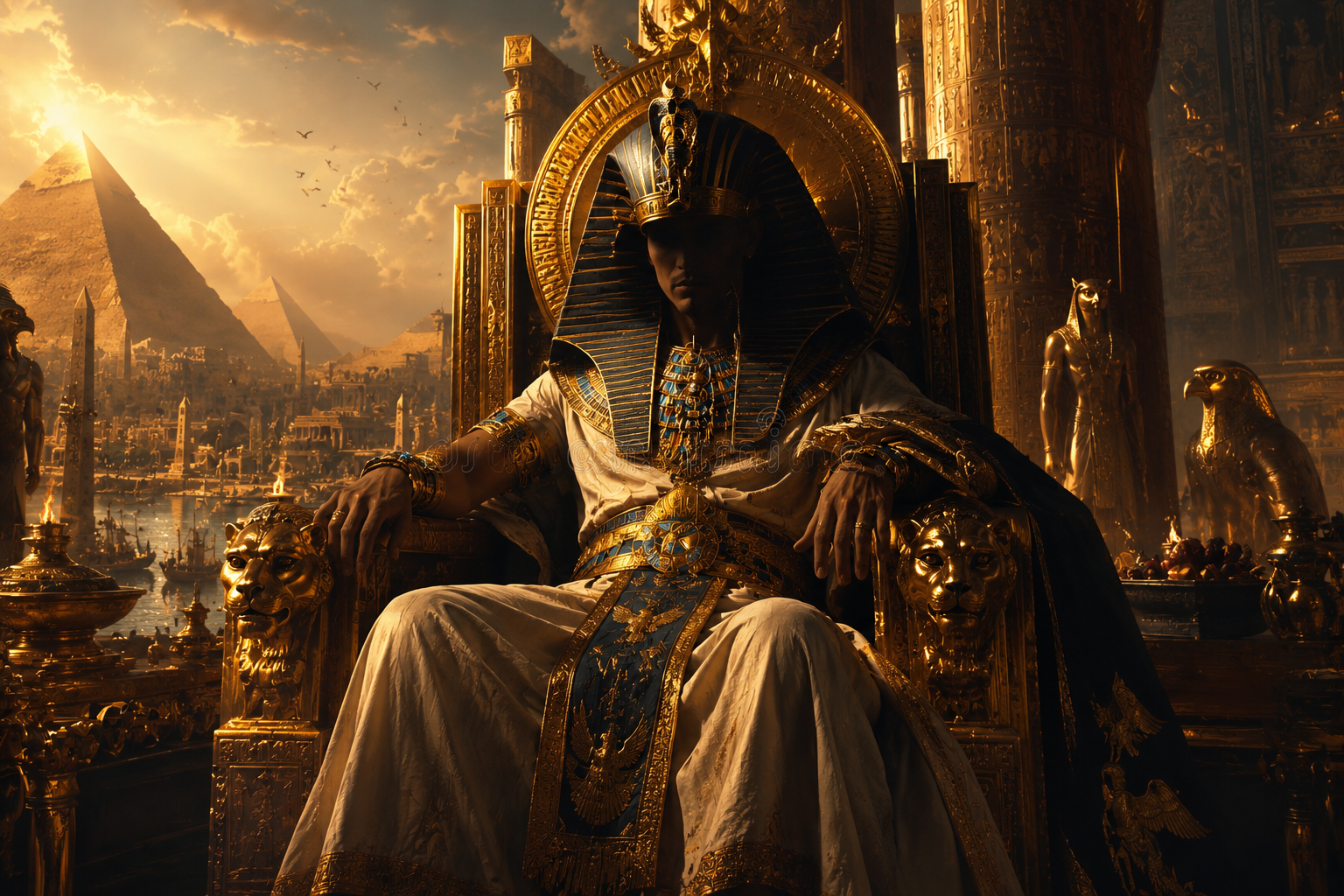
بسم الله الرحمن الرحيم
In the Name of Allah, the Most Gracious the Most Merciful
What happens when kings call themselves gods? How does power transform leaders into tyrants? The story of Fi’raun provides a striking answer. Not only did he reject Divine authority but he elevated himself to the status of god, demanding obedience to consolidate his grip on power. This article explores leaders’ fascination with self-deification and how worshipping human desires gives rise to oppression and tyranny.
The Godly Kingdom v Earthly Kingdom
Human beings are not neutral creatures. If they do not worship God, they worship themselves. Augustine of Hippo in his work ‘The City of God’, divided human history into two types of civilisations. One is the godly kingdom, who rule according to God’s commands. The other is the earthly kingdom who rule according to man. He stated:
Accordingly, two cities have been formed by two loves: the earthly by the love of self, even to the contempt of God; the heavenly by the love of God, even to the contempt of self.
The former, in a word, glories in itself, the latter in the Lord.
(Augustine, 2014, 48)
Augustine argued that humanity started as being a godly kingdom where rulers adopted scripture, seeking divine pleasure. However, over time empires became focused on wealth, power, and ego. Seeking worldly gain, the ruler transgresses God's limits to maintain his kingdom. This causes civilisations to shift from worshipping God to worshipping worldly desires.
[When] man lives according to himself,—that is, according to man, not according to God,—assuredly he lives according to a lie
How kingdoms shift from piety to tyranny can be seen through the example of Prophet Yusuf عَلَيْهِ ٱلسَّلَامُ who governed a godly kingdom, and how it transitioned to an earthly kingdom under Fir'aun (Pharaoh)
From Justice to Corruption: Prophet Yusuf to Fir'aun
Prophet Yusuf عَلَيْهِ ٱلسَّلَامُ was and righteous just ruler in Ancient Egypt. Under his rule, peace spread throughout the land. He averted famine, looked after the poor and prevented the strong from oppressing the weak.
Ibn Khaldun describes in The Muqaddimah how righteous dynasties are originally formed through divine assistance.
‘Dynasties of wide power and large royal authority have their origin in religion based either on prophethood or on truthful propaganda.’
These kingdoms are characterised by unity, in which people rally behind royal authority. This was the case for Prophet Yusuf whose family moved from Canaan to Egypt during his reign. The people welcomed them as the family of a just king. Prophets who are rulers are also supported by their populations, ‘though they could have been supported by God with anything in existence.’
The effects of Divine justice and rule unites a population, who reject falsehood and advance toward God. This is how they ‘become one in their outlook.’
(Ibn Khaldun, 2015, 212-7)
After the death of Prophet Yusuf عَلَيْهِ ٱلسَّلَامُ the people left prophetic guidance and began to distinguish themselves through class and kinship. The rich began to look down on the poor, and the strong oppressed the weak. Over time the kingdom began to change and a new dynasty formed generations later - drastically different from the last.
Ibn Khaldun describes how new dynasties are formed when tribes compete for power until one gains superiority and dominates them all. This unites the lesser tribes under the strong. One of the people in the ruling tribe must be the leader and is singled out for rule. They are someone with influence.
Eventually, the leader becomes attached to power, which produces a new characteristic:
Thus, he develops the quality of egotism, innate in human beings
The leader takes charge all by himself, as far as possible. Eventually, he leaves no part in his authority to anyone else.
(Ibn Khaldun, 2015 , 222)
This occurred after the death of Prophet Yusuf عَلَيْهِ ٱلسَّلَامُ where generations later, the Copts came into power in Egypt, replacing Canaanite rule. The leader from this group was Fi'raun (Pharaoh) who re-shaped the kingdom's social structure.
Fir’aun came from the Copts, which he made the highest class in Egypt. He despised Bani Israel, the family of Prophet Yusuf - who became the slaves. This ensured that Bani Israel or the Canaanites could not hold any senior position or status, erasing the old legacy to usher in a new kingdom rooted in tyranny. This leads to the final stage where the leader perceives themselves as invincible, rebelling against God.
The Deification of Fi’raun: The Metaphysical Rebel
Humanity has always had an obsession with becoming its own god. They rebel against the Divine to become the central authority on earth, in what Augustine had described as the earthly kingdom.
But what is the logic behind choosing their desires over their Creator’s commands?
Albert Camus in the book The Rebel describes a metaphysical rebel - a group who deify themselves through power as a means to challenge God.
They gain leadership positions through revolutions and rebellions. The rebel sees a ‘shattered world’ filled with violence, poverty and death, due to an absence of authority. Thus, he denounces God ‘as the father of death’ who is an unjust Creator.
The rebel leader replaces God to become the moral and central lawgiver. Their goal is simple:
‘To establish [a] unitarian reign of justice, if he can, or of injustice, if he is driven to extremes.’
Metaphysical rebels believe they are noble. They create and mould institutions to instil order. Most importantly, they do not see themselves as atheists but a blasphemer who does so in ‘the name of order.’ He does not deny the existence of God but challenges His right to rule.
(Camus, 1956, 15)
This is shown through Fi'raun, who replaced God as the highest authority in the land. Allah shows us his mindset in Surah Naziat:
Then he summoned ˹his people˺ and called out,
saying, “I am your lord, the most high!”
Shift into Violence and Authoritarianism
Now that the ruler has replaced God, he now shares in the desire to create. As the rebel is now the moral and central authority, they must demand control to establish order. This leads to the creation of totalitarian states and dictatorships.
In The Rebel, Comey describes how in a desire for freedom and alternate rule, most new regimes have been created from violence.
‘The majority of revolutions are shaped by, and derive their originality from, murder. All, or almost all, have been homicidal.’
This is due to the rejection of Divine commands to establish true justice. Now, it is the role of mankind to instil morality on earth, through the development of regimes and ideologies. The rebel bears the responsibility to create stability and order. This begins the desperate effort to create - at the price of crime and murder if necessary - the dominion of man.
When a slave rebels against his master, the situation presented is of one man pitted against another, under a cruel sky, far from the exalted realms of principles. The final result is merely the murder of a man.
(Comey, 1956, 56)
This means when there is no divine authority acknowledged, the fear of God disappears and the world becomes a struggle of man against man. Humanity oppresses the other to establish authority and control - leading to widespread destruction and violence.
In the case of Fi'raun, he turned to increasingly violent methods to protect his throne. Due to his rejection of God, his power became the source of self divinity. Fi'raun needed to turn himself into a larger than life figure who transcended human limitations. He had to deify himself through control and influence. Allah describes his mindset and oppressive tactics:
Indeed, Pharaoh ˹arrogantly˺ elevated himself in the land and divided its people into ˹subservient˺ groups, one of which he persecuted, slaughtering their sons and keeping their women. He was truly one of the corruptors.
Similarly, to protect his authority, he threatened the magicians of Musa after they disbelieved in him.
They declared, “We ˹now˺ believe in the Lord of all worlds—
the Lord of Moses and Aaron.”
Pharaoh threatened, “How dare you believe in him before I give you permission? This must be a conspiracy you devised in the city to drive out its people, but soon you will see.
I will certainly cut off your hands and feet on opposite sides, then crucify you all.”
Allah describes the consequences of Fi'raun’s rebellion, where he couldn’t prevent his kingdom’s collapse. Despite the earthly pleasures his people enjoyed, his disobedience to Allah ultimately resulted in the loss of it all.
˹Imagine˺ how many gardens and springs the tyrants left behind,
as well as ˹various˺ crops and splendid residences,
and luxuries which they fully enjoyed.
So it was. And We awarded it ˹all˺ to another people.
Conclusion
Overall, the rise of Fi'raun shows the consequences of an earthly kingdom rooted in human desires. In order to exercise complete control, tyrannical leaders challenge God as a means to create their own truth in the world. This leads to oppression and violence, where groups compete for freedom and further control, showing human beings cannot be just without Divine guidance. The story of Fi’raun characterises what happens when power becomes its own god - enough to try and challenge Allah, which ultimately results in ruin like previous nations.
Research Resources
JazakAllahu khair for reading. Please benefit the ummah by sharing this knowledge. Feel free to download this article for offline reading or consult the bibliography below.
-
Augustine of Hippo (2014) The City of God, Volume II. Edited by M. Dods. Project Gutenberg. Available at: https://www.gutenberg.org/ebooks/45305 (Accessed: 5 June 2026).
Camus, A. (1956) The Rebel: An Essay on Man in Revolt. New York: Vintage Books.
Ibn Khaldūn (2015) The Muqaddimah: An Introduction to History. Abridged edn. Edited and translated by N.J. Dawood. Introduction by B.B. Lawrence. Princeton, NJ: Princeton University Press.



The people of Shuʿayb were a nation destroyed for cheating in business. The cause of their downfall was viewing every interaction through the lens of profit. This led to extremes in how they treated others. Similarly, modern society has also become obsessed with profit margins over honest transactions.